

On a study trip to Finland last November I watched a small child, pre-school years, maybe at the most 5 years old, climb up onto a rock which was maybe 6-7ft from the top to the ground, and they were on top of the world, ‘look at me, look how high I am, I can see the trees’ they called out to the adult below, as they exploded with excitement, achievement and joy for what they had managed to do by themselves. This was risky play for that child.
The term risky play can often conjure up pictures of a play that is dangerous because the word risk is used, but risky play is not this, risky play is about challenge, excitement, exploring and learning to grow.
Risky play is play that most of us would have done as kids, gone outside climbed trees, climbing on or over things, exploring, jumping, balancing and running, play that had an element of fun, risk and excitement, with a possibility of injury such as a falling when running fast, a bruise or a small scratch or cut from climbing a tree. What risky play looks likes is different from child to child, dependent on age and size.
For some younger children such it may simply be climbing up on a slightly raised platform, balancing on something height appropriate for them, playing with loose parts like building with twigs and sticks, for other children it may be den building, bucket stilts, rolling down hills or climbing trees. This is where adults can support in age and size appropriate risky play, assessing the play is not hazardous or dangerous.
Why is risky play important for children?
Many people and practitioners 1 believe risky play is beneficial and important for children’s development in many ways, it supports gross and fine motor skills, physical and mental health and well-being, but not only that it supports building confidence, resilience, developing problem solving skills, looking at how to work with challenges and overcome them, it often includes collaboration with peers, developing social skills, teamwork, and communication skills.
What are some of the benefits of Risky Play?
It supports children to explore and develop their natural curiosity.
It can help with building confidence and self-responsibility, a child can learn to navigate risks, what they are capable of, how to overcome challenges and solve problems. It can help to build resilience if something doesn’t work, how to look at another way of doing it, or learning to accept that it is not possible, learning to be okay with failure, not give up and grow from it.
It can build social skills, as children learn how to work together, to build and develop connections and friendships, build trust, support each other, learn how to keep themselves and each other safe, to develop skills in communication and teamwork. It can support build physical development, with fine and gross motor skills. A lot of risky play includes things like running, jumping, climbing and building, which is important for a child’s physical development, fitness, and emotional mental health and well-being.
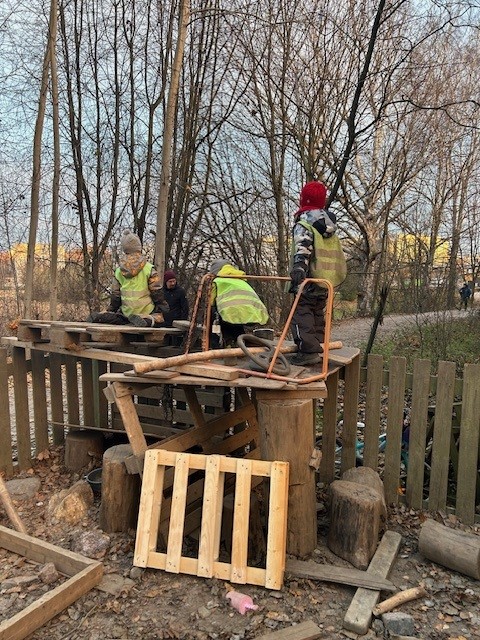
How can we support risky play with children?
As adults we can often be over cautious with children playing, which is completely understandable as we love our children, and don’t want any harm to come to them. Many practitioners and advocates of risky play suggest being mindful of the language we use to support children in their risky play. For example, instead of saying ‘watch out, don’t do that, be careful’, we can swap this for language such as;
- How are you going to …..?
- Take your time
- What are you planning to do next?
- Do you feel safe?
- Where do you need to put your foot / hand ?
- Do you need any help / support ?

Risky play is not about putting children at risk but allowing them to develop their physical and mental health and well-being, to build a variety of skills to support them and have fun whilst doing it. As adults we can risk assess the play before they children are doing it to see if it’s suitable, age and stage appropriate, the benefits, why the children are doing it, what the risks are and how we as educator can manage and support safe risky play
Get in touch today to explore a bespoke package tailored to your children and your setting.
www.positiveplaytimes.com
support@positiveplaytimes.com